Cave Bears in Prehistoric Britain

Kents Cavern offers a glimpse into prehistoric Britain, with a history stretching back more than 500,000 years. Deep beneath the cave’s familiar ice age layers lies evidence of some of the earliest animal life and human activity found in Britain, helping to reveal what life was like in this part of the world hundreds of thousands of years ago.
During the ice age Kents Cavern hosted an incredible variety of animal life. Between 60 to 20 thousand years ago wolves, cave lions, grizzly bears and most commonly cave hyena all called the cave home for some period of their life. Humans can also be added to this list, with Neanderthals and our own species, Homo sapiens, seeking shelter in the cave during the ice age, perhaps even at the same time.
HISTORY OF KENTS CAVERN
But Kents Cavern is unique amongst all other caves in Britain in that this is not the beginning of our ice age story, not even close. The people who excavated Kents Cavern throughout the 19th century quickly found out that deep beneath these initial ice age layers of Kents Cavern, which matched quite closely with other ice age caves in Britain, there lay an extremely thick, hardened, unbroken stalagmite floor, and beneath this was even more ice age sediment, containing enormous ancient animal bones. This is one of the things that makes Kents Cavern’s archaeological story so special. While the oldest bones from the majority of other ice age caves in Britain are roughly 80 – 60 thousand years old, the oldest bones from Kents Cavern are over 500 thousand years old – that's over half a million years!
And unlike the amazing variety of animals from the younger ice age layer of Kents Cavern, this deeper layer is very different. We call this type of earth the breccia; a thick layer of clay mixed with rock and gravel, reinforced with sections of stalagmite. Apart from two partial giant lion skulls, the only animal larger than a mouse that has been found in the breccia is the cave bear. They belonged to the extinct species Ursus deningeri. And we’ve found thousands of their bones! In certain areas of these deep layers, the breccia can be completely packed in with cave bear bones, teeth and claws.
WHAT WERE CAVE BEARS?
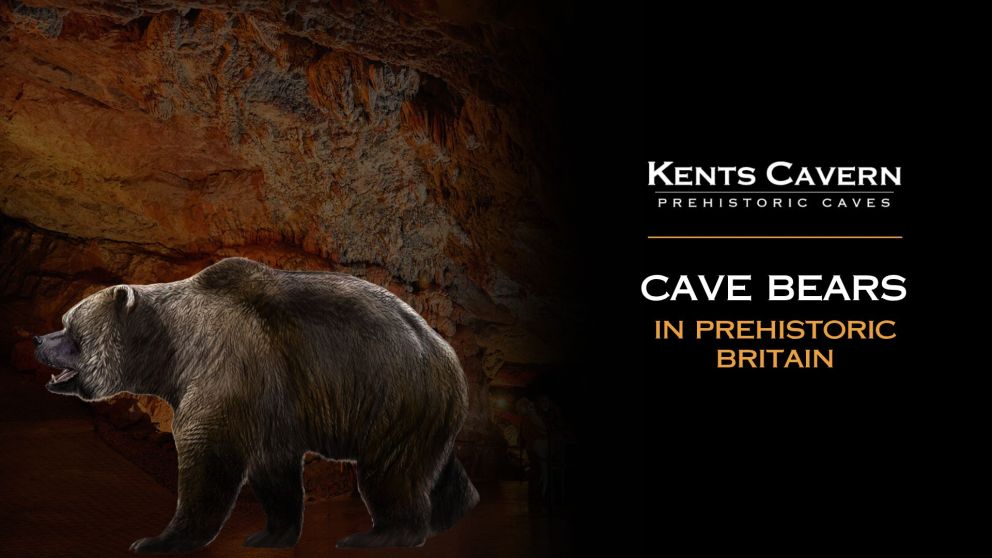
So, what were these cave bears and what did they look like? Well, we’re not entirely certain. We can have a good idea as to what some ice age animals looked like in life from mummified specimens found in areas of Siberia and Alaska. And so for animals like woolly rhinos, woolly mammoth, cave lions and even sabre-toothed cats, we know quite a lot about their colour, muscle mass and fat content. But unfortunately up until now, we have not found a mummified cave bear. So we don’t know what colour they were, or how muscular or fat they were either. Everything we know about them is from their bones. They could sometimes grow to be a bit larger than grizzly bears, there closest living relatives, being around 3 metres tall when stood on their back legs. They were slightly heavier set, with thicker bones, and for some reason has stepper foreheads. Their teeth were also quite unique, and this is because they were nearly entirely vegetarian! Normally the only time they ate meat was in the lead up for winter, when they were trying to fatten up for the winter.
Why did they do this? Well cave bears get their name from the fact that they would almost always hibernate in caves during the longer, colder winters of the ice age. Unlike grizzly bears, who hibernate in caves, tree stumps, basic holes and anything decently sheltered, cave bears seemed to have exclusively used caves and caverns as their winter dens, called a hibernaculum.
Why Did Cave Bears Become Extinct in Britain?
And this may be one of the reasons that caused their extinction. In mainland Europe cave bears became extinct 24,000 years ago; nearly at the end of the ice age. But in Britain, for some reason they completely disappear from the fossil record after 300,000 years ago. We actually think this is because of grizzly bears instead. Just before this point we start to see grizzly bears become a lot more common in Britain. They were better adapted to surviving in the cold, much less fussy eaters, and were more flexible when choosing a place to hibernate. Britain was an extremely harsh environment during the ice age; a freezing peninsula at the edge of Europe where conditions could fluctuate very quickly, and so grizzly bears seem to have just been better at surviving this environment, eventually outcompeting cave bears and driving them away from this part of Europe for good.
And because this happened to long ago, this is why we’re so proud of our cave bears at Kents Cavern. The only cave that you can visit in Britain that had real cave bears living within them, is Kents Cavern. When you visit the caves, you can still see the bones of cave bears embedded within the walls and ceiling, having lay dormant in them for nearly half of a million years.
Continue exploring Kents Cavern's archaeological story and discover more about Ice Age Britain. To experience the cavers yourself, plan your visit.
Written by Quinn Arden-Trew


 picked.cave.lively